Finding Your Creative Roots

How Watercolor Nature Journaling Transforms Your Art Practice
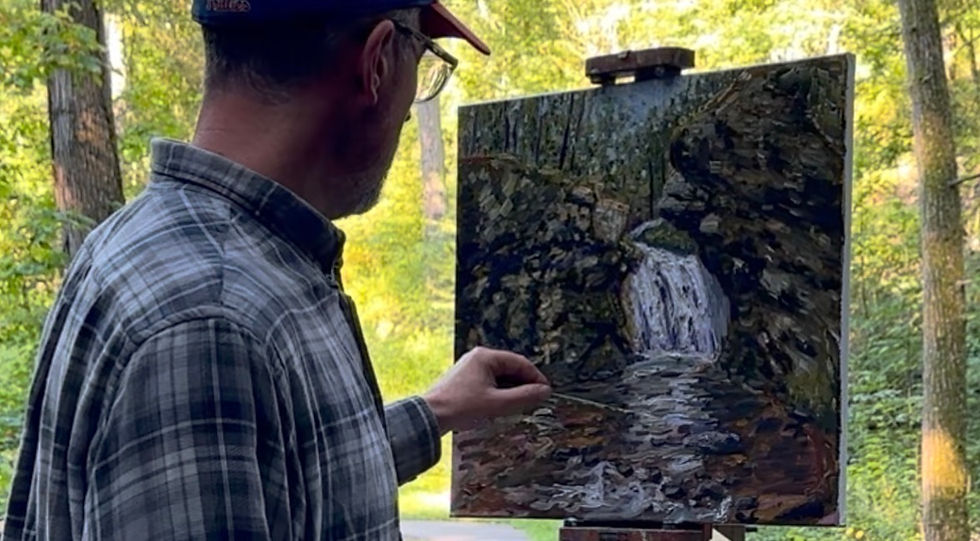
Stepping outside with a sketchbook and a pocketful of supplies does more than record the changing seasons. It builds the visual, mental, and observational foundation of an entire creative life. Whether you work on large studio paintings, in mixed media, or simply want to create regularly, nature journaling is an accessible creative laboratory.

Below is a guide to bringing nature journaling into your routine: why line and wash is the ideal technique, which supplies you actually need, and the mindset that keeps you showing up.
Nature Journaling in a Larger Creative Practice
It’s easy to fall into a studio rut or feel paralyzed by the pressure to produce polished, display-ready work. A nature journal is a low-stakes training ground and reference archive that feeds your wider creative practice in several ways:
Sharpening observational and visual memory. Journaling trains you to draw what you actually see rather than what you assume is there. Noticing details like the gnarly nodes of magnolia branches, the subtle shadows beneath petals, or the way highlights fall along the curved edge of a bud deepens your understanding of three-dimensional form and perspective in every medium.
Building a living reference library. Sketches, handwritten field notes, quick color swatches, and on-site phone photos become personal reference material for larger studio works.
Creating a safe space for experimentation. Your journal is a sandbox, not a gallery piece. You can try unusual techniques, such as staining paper with crushed flower petals,
sketching with sticks and walnut ink, dabbing on wet-on-wet backgrounds, or adding rubber stamps and collage, without risking an expensive canvas.
Cultivating creative presence. Nature journaling encourages you to slow down, notice seasonal transitions, and be fully present in the process rather than rushing toward a finished product.
Why Line and Wash Is the Ideal Approach
Line and wash, which pairs ink drawing with translucent watercolor, is one of the most practical and expressive approaches to nature journaling.
Forgiving and beginner-friendly. Unlike traditional multi-layered botanical watercolor, line and wash typically needs only one to three light washes of pigment. With no rigid rules for how lines and washes interact, it’s forgiving for artists of any experience level.
Structure meets expressive freedom. The ink linework provides immediate clarity and definition, which frees you to apply watercolor loosely. Color doesn’t have to stay inside the lines, and you can leave white paper edges showing to suggest light and movement.
Speed and portability. Outdoors, the light shifts, insects move, and the weather can turn chilly. Line and wash lets you capture the essential shapes in ink or pencil on the spot, then add washes there or finish at your studio table.
Works on inexpensive paper. Because the technique relies on thin, watered-down washes rather than soaking wet-on-wet layers, you don’t need heavy, expensive watercolor paper. A budget-friendly sketchbook works well as long as you keep the washes light enough to prevent pilling and bleed-through.
Nuanced line variety. You can match the weight and feel of your linework to your subject. Black waterproof ink creates bold contrast, while fine nibs, sepia or brown liners, and brush pens preserve the delicate softness of petals and blossoms without making them look heavy.
Essential Supplies for Regular Journaling
Art shouldn’t feel overwhelming or costly to begin. A portable, self-contained kit makes it much easier to journal consistently.
Pencils and Erasers
Mechanical pencils. Loaded with standard HB graphite, a mechanical pencil gives a dependable line, eliminates the need for a sharpener outdoors, and often includes a twist-up eraser.
Graded drawing pencils. If you prefer traditional pencils, hard leads in the H range (such as 2H) make faint guidelines that disappear beneath watercolor washes, while softer B pencils give rich, dark lines.
Kneadable eraser. This is essential for lifting excess graphite before you apply ink or watercolor. It prevents smudges without damaging the paper surface.
Inks and Pens
Waterproof fine liners. Your primary pen must use waterproof ink so your linework doesn’t smear or turn muddy when washes are brushed over it. Fine-liner pens such as the Sakura Pigma Micron or Copic Multiliner, with nib sizes from an ultra-fine 0.005 to 0.5, are dependable and portable.
Fountain pens. A refillable fountain pen with an extra-fine nib and waterproof document ink is an economical, sustainable alternative for everyday sketching and writing.
Highlight pens. A white gel pen (such as a Uni-ball Signo or Gelly Roll) or a dab of white gouache is invaluable for restoring bright highlights, leaf veins, or fuzzy bud textures over darker paint.
My personal favorite: the multicolor ballpoint pen. Ballpoints often leave broken or uneven lines, and once you get comfortable with having less control and consistency in your mark making, those imperfections become a feature rather than a flaw. A multicolor ballpoint adds another dimension to line and wash. The range of colors, combined with the broken, textured lines, can enrich your journal pages even further.
No matter what pen you choose to work with it’s always a good idea to test the ink on a scrap piece of paper outside of your journal to see how long it takes for the ink to dry and how water resistant it actually is. This step can help avoid unexpected smudges and runs as you apply watercolor paint to your line and wash sketch
Watercolors and Brushes
Compact watercolor sets. A simple pocket palette with versatile mixing primaries is all you need for outdoor flora and fauna. Cobalt blue, ultramarine, yellow-greens, warm yellows, and earth browns like Van Dyke brown make a good start.
Pointed round brushes. A quality pointed brush (such as a size 4 Black Velvet round) holds plenty of water while still coming to a fine point for tight details.
Field-Ready Sketchbook Hacks
Customizing your journal with simple everyday items removes friction in the field:
Elastic pen bands. Hand-sew or loop a wide elastic band around your sketchbook cover to hold your pen and pencil securely.
Binder clips. Clip one or two to the cover strap to hold fluttering pages flat on windy days.
Sticky notes. Paste a small pad inside the back cover so you can quickly jot down timestamps, weather conditions, or species names without breaking your drawing rhythm.
Specimen envelopes and rulers. Glue a small, heavy-duty envelope inside the back cover to hold a 6-inch ruler for taking measurements, or slip in folded paper for pressing small botanical specimens on the go.
The Mindset for Long-Term Consistency
Supplies alone won’t sustain a habit. Your mindset determines whether journaling becomes a lifelong joy or an abandoned chore.
Embrace process over product. A nature journal isn’t made to hang on a wall or impress an audience. It’s a personal practice of exploration and noticing. Letting go of perfectionism makes room for playful accidents, loose lines, and genuine fun.
Set boundaries to prevent blank-page anxiety. A wide, empty page can be
intimidating. Make it approachable with simple self-imposed limits: restrict your materials, sketch only two or three specimens per spread, or lightly draw layout boxes or text circles before you head out.
Remember there’s no “wrong” way. Your journal is entirely yours. Loose sketches with notes running off the page, detailed studies, rubber stamps, and leaf rubbings are all valid.
Relieve pressure with reference photos. Nature changes quickly, and the weather is unpredictable. A few quick photos of your subject remove the panic of losing the light, so you can establish loose outlines outdoors and finish colors and reflections later.
By pairing the simplicity of line and wash with a mindset rooted in curiosity, nature journaling shifts from an intimidating task into an indispensable, rejuvenating anchor for your entire creative life.
Cheers! Be well, Tom


Comments