Nature Journaling: A Bridge Back to the Present -- A Springboard to Awe

The Beginner’s Guide to Nature Journaling: Unlocking Curiosity, Memory, and Wonder
As a naturalist, I have observed that our human attention is a fragile thing. We are lucky if a powerful experience stays with us for more than 15 minutes before the brain’s default setting—to "select all and delete"—kicks in to make room for the next distraction. Our attention is the most precious currency we have, yet we spend it recklessly.
Nature journaling is your defense against this erasure. It is not an "art project"; it is a high-level strategy for deep observation and a primary tool for memory retention. A journal acts as a "wayback machine," creating a physical anchor for your experiences. When you look back at a page years later, the sensory details—the scent of the pine needles, the specific slant of the light, the person you were sitting with—come flooding back. By moving

observations out of your head and onto paper, you are quite literally time-traveling.

Key Insight: Attention is an act of love. By training yourself to pay hyper-attention to the world through a journal, you are not just recording data; you are offering your most precious currency to a world that is waiting to be noticed.
To transform from a passive observer into an active explorer, you must first assemble a kit that serves your curiosity rather than hindering it.
The Minimalist Field Kit: Tools for the Modern Explorer
The Essential Starter Duo
Pencil: A mechanical pencil (no sharpener needed) or a standard HB pencil.
Sketchbook: A medium-sized (A5), hardcover journal with acid-free paper.
Optional Enhancements
Watercolor/Paints: Portable pan sets or water-tank brushes for adding color later.
Non-Photo Blue Pencil: A "Prismacolor Col-Erase" pencil for making "ghosty" starter lines that don't need erasing.
Ruler: For scientific accuracy and measuring specific specimens.
Insulating Mat: A small, portable mat to keep you warm and dry while sitting. A good alternative could be a lightweight folding chair or stool.
The best kit is the one you will actually carry. Prioritize portability and simplicity to prevent "kit burnout." If your gear is too heavy or complicated, you will find excuses to leave it at home.
Technical Nuances for the Field
The Hardcover Advantage: A stiff cover acts as your own built-in clipboard. Avoid "floppy" notebooks that require you to hunt for a flat surface to work.
The Case Against Spirals: While common, spiral bindings are the enemy of longevity. The pages in a spiral notebook rub together constantly, which effectively erases and smudges your graphite drawings over time. Opt for a sewn-in binding.
Acid-Free Paper: Cheap, acidic paper becomes yellow and brittle. To ensure your "time machine" lasts for decades, invest in archival-quality, acid-free stock.
The Specimen Baggie: Keep a few "empty baggies" in your kit. These are for collecting "non-precious" items like weeds, fallen pine cones, or leaf skeletons to journal later in your studio if you are pressed for time in the field.
Once your physical kit is ready, you need the mental frameworks to fill those pages with meaningful discovery.
The Foundational Frameworks: How to "Think on Paper"
Nature journaling is essentially "thinking on paper." To engage your whole brain and move beyond superficial looking, use these two powerful triads to structure every entry.
Triad 1: The Three Languages
Using different "languages" engages different neurological pathways, making your observations more robust.
Words: Use these for specific details, questions, and poetic reflections.
Pictures: Sketches, maps, and diagrams provide a visual strategy for understanding shape and relationship.
Numbers: Count petals, measure leaf lengths, or time animal behaviors. Numbers train you to be specifically accurate. Counting prevents the common error of drawing five petals on a flower that actually has six.
Triad 2: The Observation Prompts
When curiosity stalls, use these three prompts as a "trampoline" to bounce back into deep attention.
“I notice...": State objective facts. What color is it? Where does the shadow fall?
"I wonder...": Turn observations into questions. Why is this plant growing in the shade? How did this hole get here?
"It reminds me of...": This trains your brain to be a connector of ideas. Does a pitcher plant look like a "mustached dinosaur" or a Chihuly sculpture? Making these connections is the hallmark of a true naturalist.
While words and numbers feel approachable, many beginners are paralyzed by the "Pictures" component of the triad.
Conquering "Drawing Anxiety": Process Over Perfection
The most common barrier to journaling is the belief that drawing is an innate "gift." It is not; it is a skill developed through "pencil miles." In the journal, drawing is an investigative tool, not a "pretty picture."
The Diagram Hack: If you feel your drawing is "bad," immediately turn it into a diagram. Add arrows and labels describing the parts (e.g., "toothy edge," "fuzzy underside"). This shifts your brain from "making art" to "recording information," effectively simmering down the "judgy artsy mind."
The Tracing Method: Use tracing paper with reference books. Tracing the lines of an expert naturalist forces you to see and draw the way they do, building muscle memory for complex biological shapes.
The "Zoom-In": Instead of drawing an entire bird, draw a small box and focus on one element, such as a foot or the texture of a single feather.
The Shape Method: Stop trying to draw an "animal" and start drawing geometric shapes. See a bird's body as an oval and its wing as a triangle.
The "Secret Plant" Game: Challenge yourself to describe a specific individual plant (not just the species) so accurately—noting every unique bug bite, broken stem, or exact measurement—that a partner could find that exact individual in a field based only on your notes.
Establishing the Habit: From "One-Off" to "Life-Changing Practice"
Consistency is the signal your brain loves for creating new neurons. To move from a beginner to a naturalist, you must commit to a growth mindset.
The Buddy System: Join a community like the "Nature Journal Club." Personal accountability and the ability to "steal" strategies from others will keep you motivated.
The "Go-Bag" Principle: Keep your kit hung on a hook near the door. If you have to hunt for a pencil, you won't go out. Eliminate the "negative reinforcement" of hassle.
Metadata First: Always break the fear of the blank page by starting with the "ice-breaker" data: Date, Time, Location, and Weather.
The "Start Again" Rule: Forgive yourself for gaps in journaling. There is no such thing as being "behind." If you stop for a month, simply start again.
Overcoming Inertia: For the first week, you must "force it." You are fighting the inertia of old habits. After seven days of repetition with effort, the habit begins to take care of itself.
Treat Yourself: Associate the habit with positive reinforcement. End your sessions with a reward, like a snack or a favorite tea, to solidify the behavior.
Let the Process Evolve...
Your regular creative practice can look very different as time passes.
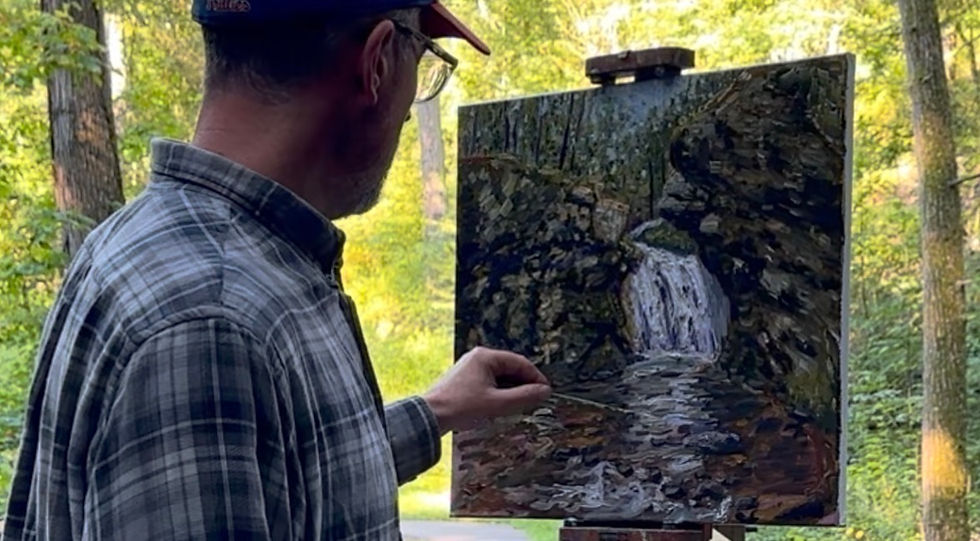
In the future it may look like a bound photo journal housing many of your recent paintings on linen sheets (after the paint dries....)

It may morph into something that resembles a large stack of small plein air sketches on panels

Conclusion: A Trampoline for Wonder
Perhaps most importantly...
Nature journaling is an act of attention, and because attention is an act of love, it fundamentally changes how you encounter the world. If you put in the "pencil miles," your skills will grow—this is a neurological guarantee. Your brain physically changes based on the work you do. The world is overflowing with infinite mysteries; it is simply waiting for you to stop, look, and record.
"I want to invite you to let your journal be a trampoline for your curiosity and wonder and an invitation for you to step more deeply into the world that has been around you your entire life just waiting for the gift of your attention." — John Muir Laws
So take a walk outside and bring a notebook and something to write or draw with. See what you notice. Take time to wonder about that thing... Consider what it reminds you of. Make a few simple sketches and take a few notes.... do it again and you have your self a nature journaling practice. Just see what happens when you do.


Comments