The Attention Paradox - How Our Inner World Sets the Stage for Our Attention & Who We Become

Updated: Jul 26
The more I experience life, the more convinced I become that the act of noticing is not a one-time event. Noticing is more of a process — one that unfolds in stages, evolves over time, and requires active maintenance if we wish to perceive the world in a meaningful way. Active maintenance is well-worth the effort because our attention and what we tend to notice also tends to create our reality and influences what we become.
"The luminous and shocking beauty of the everyday is something I try to remain alert to, if only as an antidote to the chronic cynicism and disenchantment that seems to surround everything, these days. It tells me that, despite how debased or corrupt we are told humanity is and how degraded the world has become, it just keeps on being beautiful." — Nick Cave
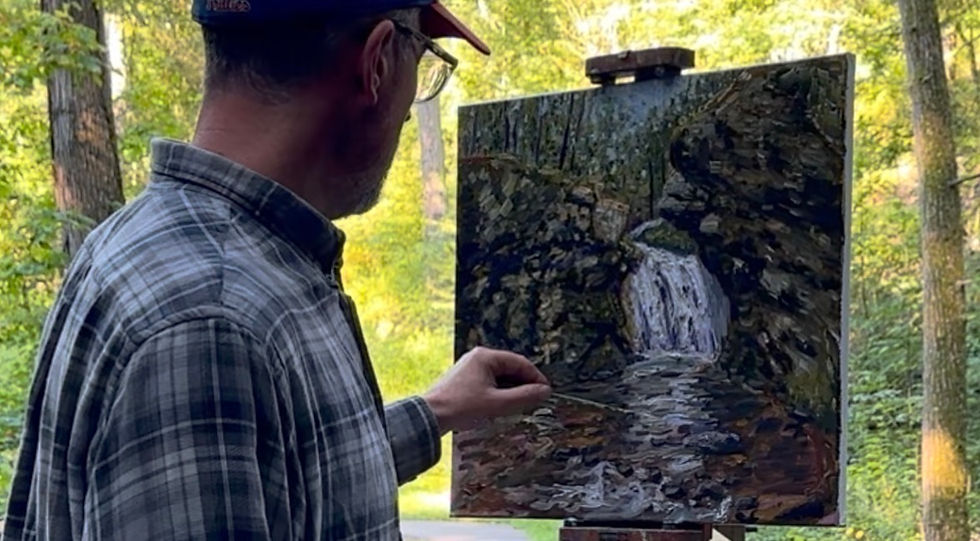
The relationship between the words attention and attend is a small but telling example of how language bridges the gap between physical action and mental focus — to attend to something is, quite literally, to be present with it. That same bridge shows up in the arts. Painting, music, and writing are all, at their core, disciplined forms of attending.
In painting, as in life, the heart is often described as the seat of true perception, far surpassing the analytical mind. When you consider the role of the heart in noticing — what stands out to you, and what you choose to focus on — and ultimately how you see, it becomes self-evident that it is of the utmost importance to cultivate the soil of your heart, so that it is well-nourished with the ingredients needed to see clearly through the lens of a healthy heart.

This is not a theological claim, nor an invitation to any particular faith. When the ancient Greeks spoke of the psyche, they weren't describing a religious doctrine — they were describing an observable truth about human experience: that our inner life, our character, and our capacity for perception are inseparable. Call it heart, call it soul, call it psyche — the word matters less than the recognition that how we see is shaped by who we are becoming inside. That is the terrain we are interested in: not belief, but attention; not doctrine, but the quality of the instrument doing the noticing.
"A writer's heart, a poet's heart, an artist's heart, a musician's heart is always breaking. It is through that broken window that we see the world." — Alice Walker
This matters on many levels. The muscle built through the effort of understanding and cultivating your heart becomes connective tissue — running from the subconscious through the entire process of noticing, seeing, and creating. It helps lift us into a virtuous cycle of healthy productivity, growth, and creative fulfillment.
"Your vision will become clear only when you can look into your own heart. Who looks outside, dreams; who looks inside, awakes." — Carl Jung
Cultivating the heart, for an artist, is a process of refining your internal filters — what you choose to notice, and how you interpret what you see. Through introspection and habit, the "heart connection" stops being a vague concept and becomes a reliable, practiced tool.
"Painting is a blind man's profession. He paints not what he sees, but what he feels, what he tells himself about what he has seen." — Pablo Picasso
Several modern thinkers on creativity and attention have illuminated the dynamics behind our ability to notice well, and to transmute what we notice into creative acts. Rick Rubin, Dr. Iain McGilchrist, Soetsu Yanagi, and Steven Pressfield have each developed their own framework for how we hone attention and turn what we perceive into something beautiful brought into the world through creative effort.
The theories of McGilchrist and Rubin converge on a foundation for creativity rooted in relational presence, the surrender of ego, and the prioritization of holistic perception over analytical utility. Together, they suggest that the creative act is a process of "midwifing" reality — aligning the brain's Master (the right hemisphere) with a universal Source of energy. Pressfield describes something similar in The War of Art, where he calls this source the Muse, and prescribes ways to commune with it despite the creative resistance that inevitably arises in everyday life.
The Right Hemisphere as the Receptive Vessel McGilchrist's theory holds that the right hemisphere (RH) is responsible for a broad, vigilant, relational form of attention — one that perceives the world as a whole and alive. This aligns closely with Rubin's description of the artist as a vessel for creative energy.
Creating a vacuum: Rubin argues that to pick up the "signal" from the Source, one must create an open space free of the mind's overpacked conditions — a shift away from the left hemisphere's (LH) narrow, procedural, and noisy chatter.
Detached noticing: Rubin's concept of awareness as "detached noticing" — allowing a subject, like a flower, to reveal more of itself without intervention — mirrors McGilchrist's description of RH presence. In this state, observer and observed become "one, not two," which McGilchrist identifies as the RH's capacity to remain open to the eternal now.
Attention as a Moral and Creative Act Both thinkers treat attention not as a passive intake of data, but as an active, moral choice that determines what kind of world comes into being.
"The brain is constantly deciding what deserves your awareness and what can be safely ignored. If it didn't do that, we'd be overwhelmed every moment." — Andrew Huberman
Midwifing reality: McGilchrist argues that we midwife the world into existence through our attention. Attend with the LH's predatory, grasping gaze, and we find only "things" to manipulate.
Translating the Source: Rubin describes the Source as a cloud-like circulation of energetic ideas that we don't own, only translate. To translate well, one must employ the RH's relational attention, which values uniqueness and context over the LH's tendency to categorize and label.
Mastery and Technique The synergy between these theories reframes the usual hierarchy of skill and inspiration.
The Master and the Emissary: McGilchrist's metaphor casts the RH as the Master and the LH as its Emissary — a useful servant of technique and skill, but a poor ruler.
Technique in service of soul: This matches Rubin's belief that while technique is a craft, the genuine impulse to create must come from within the vessel. The artist Andrew Loomis makes a similar point: proportion and lighting are technical, LH matters, but getting them right is what allows the soul and character (RH) to be revealed.
Unconscious Grace and the Flow State McGilchrist and Rubin both point toward a state of "unconscious grace," or flow, where the boundary between artist and universe dissolves.
To enter this state, the artist must bypass the LH's symbolic system — the mental shortcuts and iconography that prevent us from seeing what is actually there. Rubin notes that "talent is the ability to let ideas manifest themselves through you," which harmonizes with Soetsu Yanagi's description, in The Beauty of Everyday Things, of the artisan working in "blessed unawareness," where the hand becomes the "hand of nature."
In summary, McGilchrist offers the neurological framework — the shift from LH to RH — for the spiritual state Rubin describes as the creative vessel. Creativity, in this integrated view, is the act of quieting the LH's desire for control so the RH can resonate with the Source, midwifing a reality that is beautiful, good, and true.
It seems that a balance of opposites — work and rest, stimulus and quiet, scientific and spiritual awareness, cultivation and letting go — is what, when harmonized, produces a better quality of noticing and attention. This is the paradox at the center of the notion that noticing is not simply something we do more of, but something we tend to, the way one tends to the soil in a garden.
What we give our attention to, we tend to notice more of. Our focus becomes our reality — what we ingest, in the form of information, imagery, and recurring thought, will heavily influence what we notice next.
Anyhow... here's to our inner worlds, our attention and our effort to cultivate it!
-Cheers!


Comments